Pages

Friday, January 31, 2025

January 2025 wrap-up

In January 2025...

https://img.freepik.com/free-vector/vintage-illustrations-mandarin-duck_53876-62126.jpg?t=st=1737390779~exp=1737394379~hmac=7d15ce1252823ccb86b0ea92d324c51ece72375638fda9202d0c9fdfd6a7bb39&w=996

Played: Creaks (2020); Obduction (2017); Scar of the Doll (1998; 2017); The Caribbean Sail (2017); Eric the Unready (1993); Stars Die (2020); Cocoon (2023); various shooters

Got: nought

Favourite: The top 3 is Creaks, Obduction and Eric... but the favourite has to be Obduction. It was a new experience and finally let myself get immersed into a type of mystery I hadn't managed to before. The "ah-ha!" moments are delightful and the pace that you keep cracking them away and progressively unpeeling the gameworld is sublime. By the end it does become unfortunately absurd in its mechanics but, in a way, it too was memorable.


Read: Home Computers: 100 Icons that Defined a Digital Generation; História de Portugal em Datas; Blackadder: The Whole Damn Dynasty; The Dreamcast Encyclopedia.

Got: Dreamcast Encyclopedia, GameCube Anthology, Blackadder: The Whole Damn Dynasty, Alan Partridge: Every Ruddy Word, Teddy Boys by Max Decharné

Favourite: Blackadder: The Whole Damn Dynasty. It had been too long since I had dove into this series and I had a fantastic time, rediscovering it. The fact that it was by reading the scripts instead of by watching it does not change a bit. I love this medium as everything is as memorable in my head than if I had seen it.


Listened to (new): nought

Got: Rose City Band - Sol Y Sombra

Favourite (new): nought


Final thoughts: This month marked the restart of writing after a long hiatus. I seem to have taken to it and managed to put down my thoughts on a few subjects. It was also marked by a few other conscious decisions like buying less games, or not buying anymore from the "Az" book store.
 

So far, so good. I managed to not only replay games I was fond of, but also rediscover a few I had bought before but hadn't really got stuck in them. Books-wise it was a bit more mixed between new and old as I started the month with another big order. I will have to try and be less fanciful. Music-wise things are somewhat muted because I have mosty listened to music when driving. My strange mental block with YouTube is now almost come to one year. I will have to go back into it sooner or later. I must surely have dozens if not hundreds of videos to listen to, and I'm sure a good deal of them will be good. New artists I haven't heard yet, and artists I already know and love with new songs and records.

February is the shortest month of the year. I don't expect drastic changes from January. In part due to the bitter cold of January I have neglected playing the guitar. I could point to this as my goal for this month. To listen to and to play more music.

Stars Die (2020)

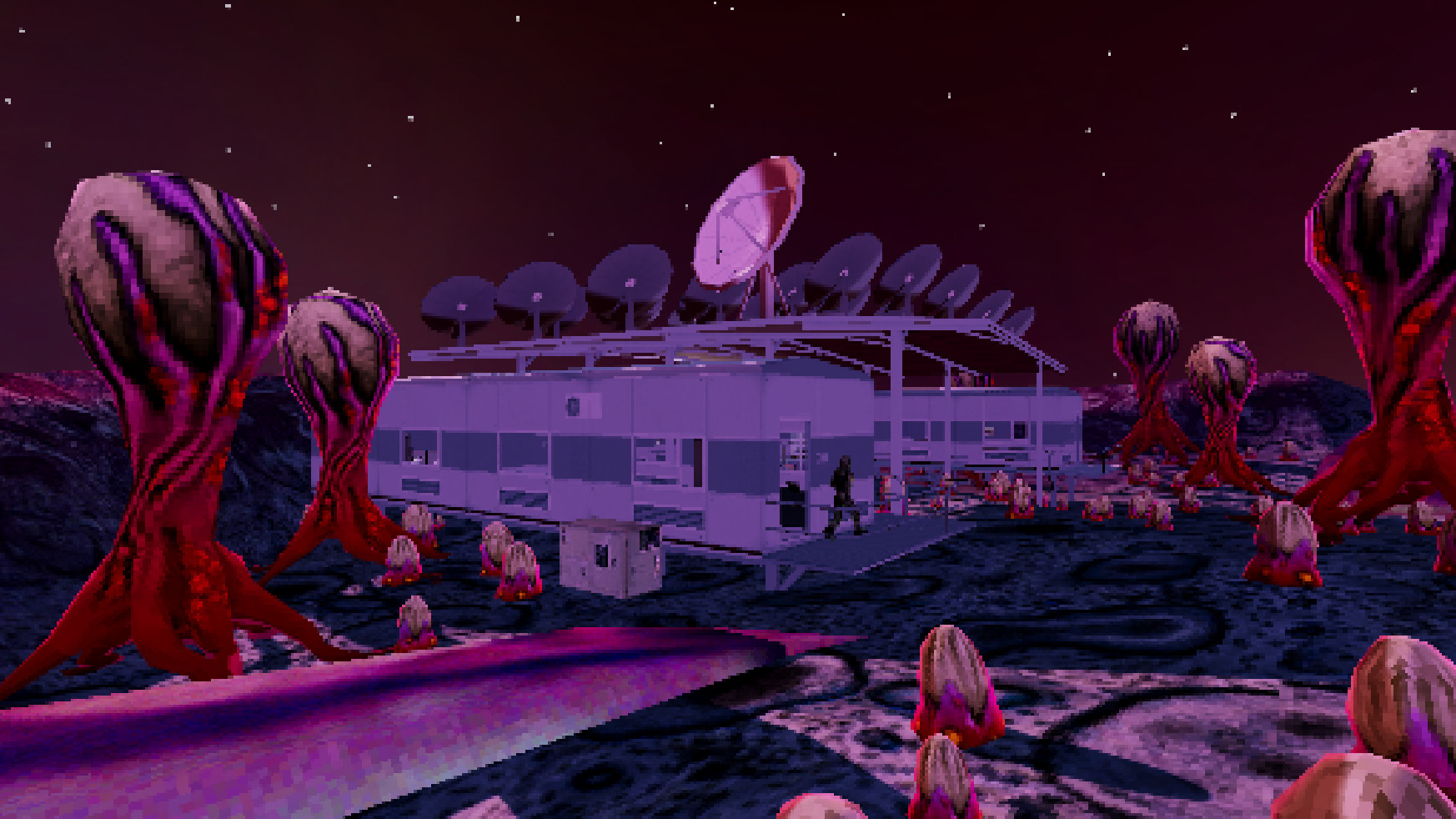
Stars Die was an impressive début by Eric Juvi and his team. Mechanically it has lots of things that remind me of a mix between Outer Wilds and Sentient with the obvious fact that this is a necessarily more restrained experience coming from an independent developer. Having played it once before in 2022, and with 5 more endings to go, this was a game that stuck in the memory as one to replay in the future.

Immediately you’re off to a great start, with little information as to why you’re on a boat that’s heading into the strangest island you’ve ever seen. You soon discover this strange island is already a base for some sort of scientific research. How you get out is now your choice (fuel’s out, by the way).

The gimmick here is both the real time clock, as well as a conversation system that attempts to be very skeptical of what NPCs tell you and, for that reason, appears less game-y and more realistic. Being able to second-guess or operate in a way that’s different from video game logic gives you more freedom in how to rationalize your approach to the story even if the end result is more or less the same and sooner or later you are forced to make a decision and suffer its consequences story-wise.

https://shared.cloudflare.steamstatic.com/store_item_assets/steam/apps/1457740/ss_8cab4d69098486ad66268d13c90b56e067ff180b.1920x1080.jpg?t=1733659859

The meat of the game, that warrants multiple playthroughs, are the interactions, motives and schedules of the 4 NPCs and yourself as the main character and, in a way, the island itself. For this reason the characters are complex. Even though you might only have one or two conversations with each, they have their specific reasons and motivations for being on the island, and for wanting or not wanting to leave it. This gives them a lot of depth and, in a way, you end up being able to relate to each and everyone of them. They all have specific schedules that happen at determinate times. You can make use of a radio to know where each character is, or even to set up a meeting somewhere at a certain time, and characters will traverse the island in real time to that destination.


One unfortunate aspect of the game that is needlessly confusing is traversing the world. The island is, of course, quite weird, yet your movement is more akin to a speed racer on a Wipeout track, and you glide away through confusing and quite long tracks (for lack of a better term) as you attempt to reach the designated area you are supposed to get to. Should you fall off a cliff, no problem, you just keep walking on – and feel free to take comically large jumps. This breaks immersion even though you might accept that perhaps reality’s rules do not apply in this place. I can understand this choice as a way to let you freely explore the strange world and to add time and distance between places but, in pratical terms, and because you’ll be replaying the game, you end up feeling like you’re doing laps following the other characters around the map. I feel, for this type of game, it would probably be beneficial to have a different approach to character tracking or perhaps better defined areas, like a text adventure.


A relaxed playthrough, pondering over the story and taking in the lo-fi vistas will hardly take an hour. In the end, most of the gameplay is centered around about 4 or 5 key conversations and travelling between where these happen. Even though the island is mysterious, it’s not overwhelmingly large. The characters themselves may have a lot to say, but they will only talk about matters at hand. There is also a decent amount of secrets, especially considering the scope of this game, that you’ll need to discover to see all endings. The story, perhaps because this game came out in 2020, focus somewhat on doom through life, on the unknown and on paradigm shifts. As you go through each playthrough and explore different options you get the full picture and realize a lot about yourself – and by this I mean not only your character, which is as mysterious as the island, but your own self as a person.


This is perhaps the game’s biggest virtue and the one that made it so interesting. As you peel away the story you discover that people are indeed complex, that perhaps these 5 characters are 5 personality traits, 5 little voices in your head, that all are valid and that are not dogmatic, they second-guess themselves. This perhaps shows, in the end, that we can only solve complex problems and go through crises when we hear everyone out and understand each others’ actions and motivations. Notably, when faced with the same problem, people react differently, whether because they gauge risk differently or because of their own sense of self. Thus, as a message that could only be conveyed through interactive media, it’s become game as art.
What we have on offer here, then, is an intriguing, replayable, experience worth more than its price of admission. An inquest into personality when push comes to shove and, on a more base level, a satisfying exploration of a complex but contained sf story. For these reasons, and unless you need gameplay with more action than introspection, it’s hard not to recommend this one.

Thursday, January 30, 2025

Blackadder

Everyone knows Mr Bean, perhaps the most recognizable (almost) silent comedy character post Chaplin's "The Tramp", even if a lot more basic and "grosser." When something gets so popular it becomes part of the cultural fabric it's sometimes easy to dismiss. Mr Bean's original TV series were so much better than any of the movies.

Vintage illustrations of Java Sparrow


But what is even more surprising is that, having created this iconic silent character, Rowan Atkinson also excelled at one of the wittiest characters in British TV, that of Blackadder. It had been decades since I had last seen the show and I had forgotten some of the details but not the broad strokes. As its four seasons follow four distinct characters in four distinct time periods (each a descendant of the next), what is curious, and a detail I had forgotten, is that their standing within their own universe is different. In the first season, Blackadder is the cowardly second son of Richard IV, and he intends to become king. In season two, he's now a witty and sarcastic Lord councillor to Elizabeth I, and he intends to put down his archrival Lord Melchett as the Queen's favourite. Then in number 3, he's now a butler to the oaf Prince George, future King George IV, and he intends to become rich to escape this ghastly life. Finally, in the last season, he's a captain during WWI, and he intends to survive or escape war.


It's hard to say which is the best as they're so different. The fact that it revolves around historical reenactment and not a character that's set in stone allows for a lot of variety in terms of episodes, which pretty much are all classics (just 6 episodes each season - plus a few specials with characters in different eras).

Often we are doomed to think "oh, if they ever did another season..." but, like many classic shows, there'a certain quality in it being a complete finite piece, even if (almost) everyone's still alive. A product of its time, sure, but also the fact that it was what it was, warts and all, and the episodes that do exist become a lot more special for it.

Friday, January 24, 2025

Eric the Unready (1993)

Eric the Unready

Eric the Unready is a very well developed game, a fact that is betrayed by its sarcastic and comical setting. Having coming out at a time when text adventures were quite passé (came out the same year Myst did), it takes that fact by making it perhaps one of the strongest and most streamlined games of its kind. Apart from the interactive and well-made graphics, the game accepts parser, clickable hotpoints on screen and a drop down menu, as well as a text only mode. Complementing the pictures, the descriptions are plentiful and endearing and there is even a Beyond Zork-like map. I wouldn’t say every joke is a hit, particularly some which are even for 1993 were already past topical, but it is well written, the rhythm well paced and even something that falls flat might still originate a low chuckle.

https://blogger.googleusercontent.com/img/b/R29vZ2xl/AVvXsEgRBO7yDPnQg_4pknuAgH1rAWtBuAAFwf7bkfAD_-U1g5gSEdtA8aPRkKLAhcbkcCSuNwtMM97qTtdfIxzvXDhsSWBfLnK0ny-wtIdUqCkK4vcEamiiG7gLoozDxN0BNijTgc8V9bK7hGw/s1600/eric_039.jpg


The setting is that of the bumbling unlikely hero in a time of medieval cloak and dagger along with a lot of humourous anachronisms and magic. Bumbling heroes are, of course, a dime a dozen in adventure games, a staple that has proven time and time again to be a good fit for this medium as the various interactions with the gameworld inevitably result in hilarity. There are of course many classic medieval games, especially King’s Quest and Defender of the Crown and Eric rips into them delightfully. One also imagines there is quite a bit of Spamalot in here as references are not just limited to computer games – later a whole episode on Star Trek and many other topical references that have lost relevance or meaning.


Despite the game being long and with many locales, unlike Zork or Adventure type games where you can freely roam around the map and have a few puzzles to solve at the same time, here you’re usually presented with a setpiece at a time. Think of it somewhat like an episode, as almost everything is self-contained, apart from some items. This makes the game a lot more focused and less frustrating. The absurdist setting might presuppose equally absurd puzzle solutions but it is not (always) so, at least at first. For the most part puzzles make sense and are not absurdly challenging. The story strings you along and what you need to do is clear and how to do it as well. The streamlined gameplay makes interacting with the gameworld a breeze. Even while I preferred to use the parser it accepted complex sentences and “understood” most of what was thrown at it. Nonetheless, perhaps due to the comical and magical setting, some puzzles do take some imagination to fathom and are occasionally groan-worthy in their solutions (in particular pun-based solutions). Some episodes, then, are quite harder or easier than others, and not in a continuous way. Apart from the very last one, which was more frustrating than hard, the second to last is quite accessible, though two of the middle ones were quite difficult to get through.


In all, a fun game to play, with many mechanics implemented to reduce frustation, a simple story that is most enjoyable as small episodes and varied gameplay. A note as well for GOG version (presumably Steam’s as well), which includes not only the scan of the original manual but an original hint book as well with both vague and specific hints. In all, a very complete package that, while making fun of its history, is at the same time one of the most accomplished and entertaining commercial text adventures I’ve enjoyed.

Thursday, January 23, 2025

The Caribbean Sail (2017)


The Caribbean Sail is a rogue-like that is a bit different. You play a Captain who takes possession of his first ship and crew. There are two skeleton stories, one more grounded in reality, the other more on the realm of fantasy, both involving pirates. 

https://shared.fastly.steamstatic.com/store_item_assets/steam/apps/657690/ss_91cc97cfcfda02880fe7eb6f268cf5bc3331afb9.1920x1080.jpg?t=1736607577

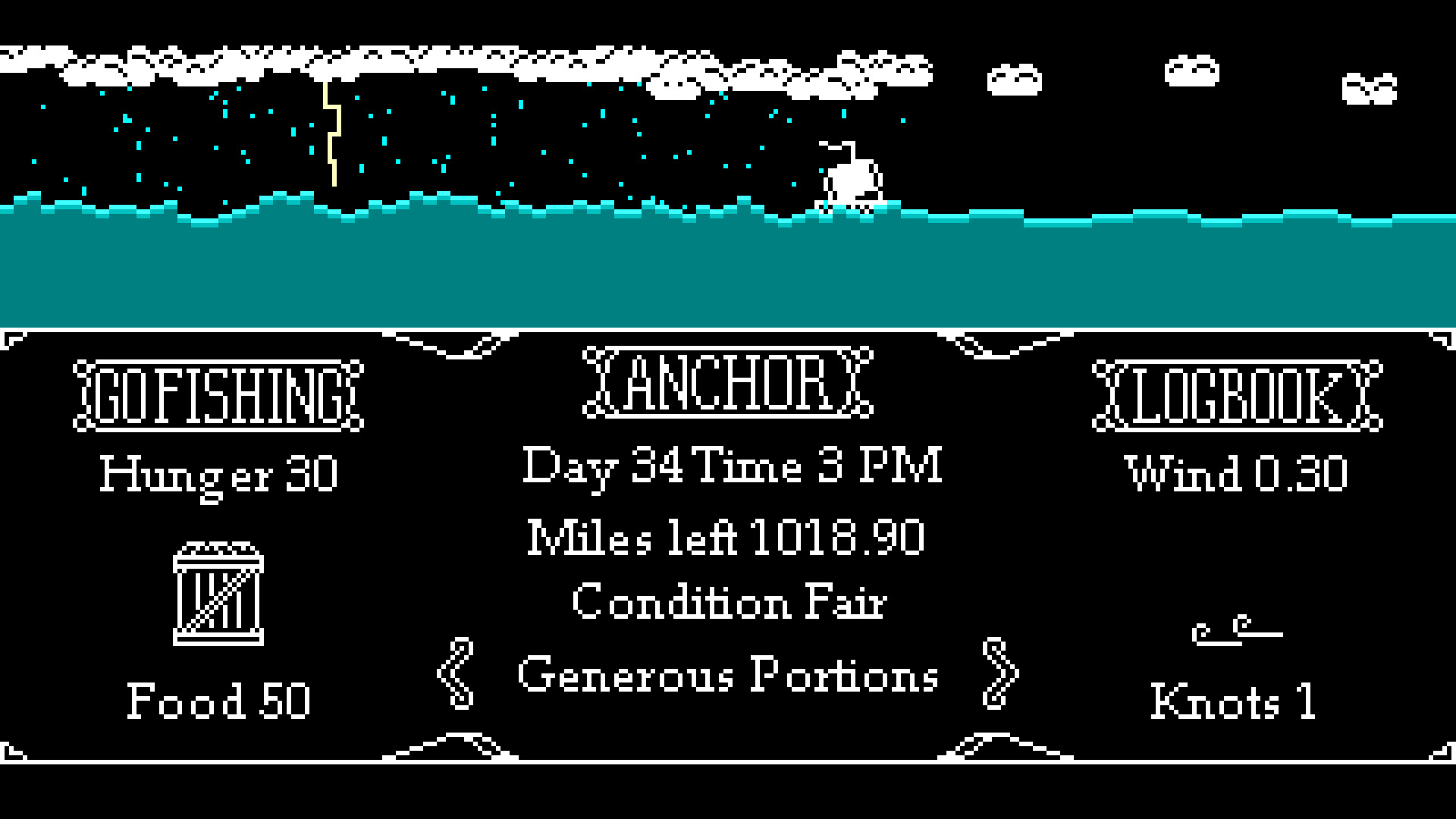
One of the main aspects of the game has to be its presentation. Retro-looking, with strong white on black features and great use of colour, it strikes a note between DOS and late Apple II games. It’s clearly inspired on some classics. Obviously Uncharted Waters and Sid Meier’s Pirates, but also The Oregon Trail.

You are then tasked to explore the few ports of the world, taking merchandise and attacking or being attacked, at the same time trying to keep alive at sea over hunger, disease, mutiny or just plain cruel luck.

For its retro presentation the game is surprisingly deep, with a few subsystems like fishing, keel sounding, ship upgrading, character upgrading, a reputation system, a “Mexican” standoff, among others. By themselves the systems are simple, but as they interplay, things get interesting. As in any rogue, luck and random events has a lot to do with the challenge. How you deal with them and how well you've developed your game will play a lot into success. 

Unfortunately it also commits the usual sin of rogue-like game design. Playing more is as rewarding as playing better. This means that the longer you play the less challenging it gets as you progressively unlock better ships and character backstories which have better skills or deeper starting funds. Thus, there is no scaling of the challenge, as what was unfathomable at first becomes trivial later. There is a long list of upgrades but, in the end, they do not impact gameplay significantly. The challenge then ends up falling on luck, as a bad spell can have devastating consequences - in the standard mode death will erase your save (keeping of course everything you’ve unlocked for subsequent runs).

You can take it not for more than what it is. Sooner or later you’ll realise you’re just playing with chance algorithms, random events get repetitive and upgrading for the sake of upgrading will feel like ultimately a waste of time. 
Yet, on the other hand, the game is perfect for what it is. The setting is fresh and the presentation inviting. This is a small, ambitious game that provides quite a bit of play within and, as you explore the world and deal with tough, split-second decisions to try and brave through just those few more nautical miles and into harbour, there is that spur to keep your save going, try for one more run from Belém to Shanghai if your ship will take it.

Wednesday, January 22, 2025

Scar of the Doll (1998; 2017)

 Late last year I played three remarkable old style Japanese adventures, on the trot: Retro Mystery Club volumes 1 (The Ise-Shima Case) and 2 (The Beppu Case) and The Hokkaido Serial Murder Case The Okhotsk Disappearance (~Memories in Ice, Tearful Figurine~) [posted in the 2024 retrospective]. What made them remarkable? Perhaps first, as someone who lived through the lean years of Japanese imports, the fact that these games are even coming out is amazing, let alone Okhotsk being remade 40 years after release. The other is how fresh they seem. Japanese-style adventures came up late. Earlier home microcomputers notoriously had difficulty in allowing the various “alphabets” used in the Japanese language. This made difficult the use of parsers. Not much later, the domination of the Famicom at home instituted a menu-based interface. This makes these games less of a chancer in terms of trying to guess what the parser will recognize but does tend to make them very straightforward. Thus what came to be called visual or sound novels were born. Still, the average visual or sound novel is either an erotic embarrassment or a teenage cutesy drama. So the freshness is how mature these games look and feel. The themes are grim and hard, and the tone is serious. A far cry from the usual light-hearted stuff.

https://shared.fastly.steamstatic.com/store_item_assets/steam/apps/564700/ss_2fb724b84e8ce01142fd4a737d268ad40807ad16.1920x1080.jpg?t=1728957081

Scar of the Doll was a small and unexpected indie/doujin hit when it came out in 1998. Its developer is sparsely credited, mainly known for the PS3 exclusive Folklore, which was critically claimed but flopped commercially. At this time there are two versions on Steam. A 2017 version that translated into English but kept almost everything the same, including music and art-style and a 2023 remake version that, unfortunately, redraws the original art to a generic modern anime-like (and costs over twice as much). I have only played the 2017 version.

Gameplay is very limited. It’s all menu-based which offers you some options to move between areas or decide whom to talk to. The challenge relies on making the right choices. A “wrong” choice invariably ends in a game over. Thus, it’s somewhat a game of attrition to constantly replay scenes until you figure out the right choice to move on. This makes it sound like an incredibly dull task but there are a few design options that ease this pain. The first is a small but useful hint at the end of each game over that tells you what you did wrong or didn’t do right. The other is the fact that you can save quite often, so a replay can only be a case of replaying one scene, and not the whole game from the start. The game over situation adds the necessary amount of tension to proceedings, in addition to the thriller-type storyline, and gives this the description of a game, rather than just a book, which you read passively. The game world is quite small in terms of locations but, as any interactive fiction player knows, this is a plus, as it makes the story and exploration more focused. The art-style is sparse but, for me, quite charming. It does look somewhat antiquated, and I have to assume it felt so already when it came out in 1998.

Finally, a game like this lives and dies by its story. Without spoiling it, this starts as a missing person investigation and later introduces some science fiction undertones but still grounded on the present day, planet Earth. By this I mean that thematically it explores the ethics of scientific advancement. Do not expect laser guns or spaceships or anything of that sort. The action is mostly set in a university lab and most of the characters are in that periphery. Being a short story (point to point, not taking in the need to replay scenes), characters are somewhat well developed.

Is this game worth it? Yes. I don’t think there’s anything quite like this, in an official English language version out there. At $4/€4/£3.40 full price for three hours of your time even if it’s too alien an experience for action gamers or someone who is just not into this, I’m sure no one will feel cheated out of their money either. At discount it’s an absolute steal, even if you treat it like an interactive book rather than a game. There just isn’t anything quite like this.

On a historical note this is quite a remarkable game for being a hit for computers in Japan in 1998. Remember this was the year when Metal Gear Solid came out for the PlayStation (another Japanese game that explored similar themes, although in a more militaristic way), inaugurating the modern cinematic game on consoles – right on the other end of the spectrum of Scar of the Doll.

Tuesday, January 21, 2025

The Complete Scripts...

I’ve enjoyed reading TV series scripts for a long time. At a time when seeing the episodes on demand was not an option I avidly devoured Monty Python’s Just the Words. Later, I enjoyed in my small collection the complete Royle Family, the season 1 of Green Wing and Karl Pilkington’s shows with Ricky and Steven for the radio. These have been great especially to relive the shows. Over the past few months, another series I enjoy very much, Inside Number 9, has been coming out with their scripts, three seasons a volume. As a rare case of longevity for a British comedy show, the fact is I had only watched the show up to season 6. My cable provider stopped handling BBC Prime and I was left without a legal, simple, way to watch it. Thus the last volume of the book of scripts, season 7 to 9 proved a revelation. I was able to enjoy episodes I was not familiar with in a way I did not think previously would have been possible. Images started forming in my mind just like I was watching a show. I had a lot of fun with it and I would consider pretty much an equivalent to watching the show. It’s true you may miss something with the cinematography, but the mind’s eye, as well as the keen writing puts it in a different league. You may lose something but there’s something to gain that can’t just be shown on screen.


This revelation enthused me to pursue more book scripts. I got the Fawlty Towers one (quite familiar with the show) and now the complete Black Adder and the complete Alan Partridge (only sporadically familiar with either). It has to be said, while both Rowan Atkinson and Steve Coogan are great actors, they’re great writers too, and they were also abetted by other great writers like Richard Curtis, John Lloyd, Ben Elton, (for Black Adder) Peter Baynham, Armando Ianucci and Patrick Marber (for Alan Partridge).

I have to recommend these sort of books as a great way to relive favourite episodes or discover unknown ones. They all seem to also have a bit of “flavour” text or commentary that makes them that little bit more worthwhile (over just watching the show). In a time of increasing digitalization and lack of ownership or artistic media this has been, to me, an affordable way of enjoying my favourites, in a way that is also collectable.

https://cdn.pixabay.com/photo/2023/03/06/14/27/rain-7833614_960_720.jpg