
Thursday, January 13, 2011

Friday, January 7, 2011
Metal Black

Although born as Gun Frontier 2, Metal Black feels much more like a sidequel to Darius. The gameplay however is dissimilar, and mainly stands on collecting orbs to power up a laser weapon, with no other weapon variations avaiable (although the more orbs you collect the more powerful standard fire is as well).
This laser weapon is put to devastating effect especially against the bosses, who have laser beams of their own. If both the player and the boss initiate a beam the effect is very similar to what you’d see in Dragonball, with a big sphere of energy slowly heading against the weaker of the two (depends on how charged the beam was) with the end result truly apocalyptic explosion. This of course is incredibly satisfying.
While not exactly “bullet-hell” it does present quite a bit of action on-screen, which is somewhat rare on horizontal shooters, which usually seem to favour narrow corridors and shifting-terrain to keep movement difficult. The Metal Black ship also feels quite heavy or slow, almost Invader-like, perhaps to give an idea of power.
There are 6 stages and a couple of bonus stages, although it is still a moderately difficult game. Unlike Darius the stages are sequential and cannot be chosen.
Graphically the game’s incredible not much by enemy design (again, mostly lifted from Darius), but especially due to the special effects in explosions and the fantastic backgrounds. Along with SNK’s Last Resort this might just be the most impressive looking shmup of that generation.
The music while not as interesting as in Darius Gaiden is still pretty good.
Playing through it I realised with surprise how much Invaders Infinity Gene ended up borrowing. Many of the enemies, the powerups and even the evolutionary design seem to have been lifted from this incredible game. More than an hommage to Invaders per se, Infinity Gene seems to be the evolutionary synthesis of Taito’s shoot em up genre history.
G-Darius and Border Down (G.Rev) also seem to have been favourably impressed with the game and have borrowed several elements as well, however I haven’t had the chance to delve into them.
Satakore have an incredible gallery avaiable, as well as a video of the "arcade-perfect" Saturn version.
The game is of course also avaiable on Taito Legends 2 (Xbox, PS2, Windows)
Wednesday, December 29, 2010
Trip

I was reading through the uploaded content of this old UK, mostly ZX Spectrum- centered mag called CRASH, which ran from 84 to 92 and had about 100k circulation at its height. Pretty big, moreso in those times. And, among much else which some might not find as interesting, I found this interview with legendary EA founder, Trip Hawkins, from issue 46, from November 1987, during the Personal Computer World Show, an annual (from '79 to '89) trade fair held in London, organized by Personal Computer World, another magazine (which only closed 2009, though).
http://www.crashonline.org.uk/46/pcw_ea.htm
Anyway... Even though the interview is made in the old school style of article form, and not in direct speech, it's a very interesting read, and one can see how right Trip was in how he saw the industry would evolve from then.
The advent of the standard Windows-run IBM computer for game development, developing games for an older generation and women... even how he compares games to other art forms and sees the need to make them about real life and people.
And of course how in '87 you can already see a hint of what's going on his head which will ultimately lead to the unfairly ill-fated 3DO.
Overall, a very interesting piece on this somewhat forgotten genius.
Wednesday, December 8, 2010
Way of the Samurai 3 short review

What it means to follow the path.
WoS3 is the first game of the series on this generation of consoles, debuting for the first time on a Microsoft machine, after 9 years of Sony exclusivity. The premise of this 3rd game is however unchanged: you play the role of a ronin (an unemployed samurai, so-to-speak) during a particular conflict; this time the story/ies unfold in the Amana county during the Sengoku period (the civil war which ultimately led to the unification of the country). Four factions can be aligned with, the result of which shapes your playthrough’s unique story.
Indeed for a game which develops itself unto the general idea of an almost Shakespearean setting (one can understand Akira Kurosawa’s obsession with the writer in his period-films), and that places the burden of unfolding that drama solely on the actions of the player-character, giving so much emphasis on understanding the character’s ambitions, it is more than a little queer how little relevance and presence the lead is granted: the player is forced inauspiciously into the role of stage director, an almost invisible presence in the production. This is not to say that effort was not made to go against this, although it seems poorly executed. You can make very egotistical choices to attain more powerful roles within the drama, you can decorate yourself with a slewth of accessories and apocriphal customization options, but these aspects seem to detract even more from giving charisma to your character. In the end, you either become a walking anachronism or an invisible mute.
The best way it did manage to give relevance to your actions (the one way to define yourself in the world of Amana), is through the reaction you ellicit from vulgar NPCs (but rarely in story sequences). Generally, you’ll become well loved, loathed or ignored in the various regions and to the various factions that compose the meta-world. This leads to the game’s main source of charm, as characters might kick you, praise you, or follow you around, considering your actions. The variety of responses are a good way to compensate for no voice-overs in non-story sequences, as they’re quite varied and entertaining.
This might constitute the most relevant and charismatic of a game that does little to distance itself from its predecessors storywise and rewards players with sandbox tinkers, like the before-mentioned accessories, invisible mode, instant-kill difficulty or being able to play as an NPC you’ve blunted.
This little world gains credence as per the people that inhabit it. You have the snooty castle soldiers, the rude rebels, the annoyingly humble peasants and the greedy merchants. Their character flaws, despite slightly exaggerated, but within reason, give a layer of humanity to the game, and are a far cry from the robot-personality of most western open world games. This is better emphasized in the new partner system, which allows you to develop relationships throughout the game, enabling you to know some otherwise irrelevant NPCs a little better.
Above all, WoS3 is a game that prides itself in its uniqueness. There is a constant feeling that not everything has been seen, and of an incredible depth that isn’t avaiable on the first playthrough. Its fault is that it pratically purportedly takes away most of its juice from the casual player and rewards only the most hardcore gamer. While a single playthrough might take some 3 or 4 hours on your first try (and can be concluded much quicker), the game is actually meant to be played for dozens upon dozens of hours, as you finally understand just what it means to follow the way of the samurai.
Saturday, December 4, 2010
Another World - 15th year appreciation
"The creation is an iterative process where we progressively refine our ideas."
- Eric Chahi
Despite having reviewed the 15th Anniversary Edition of Another World earlier, only recently did I have the pleasure to explore the addendi of the package, namely the making-of featurettes. Comprised of two small notebooks (one of them Chahi's technical programming scrapbook, which I'm afraid I could grasp nothing of) and a video, they do however give a relevant, albeit short, insight into one of the most accomplished works in the medium, and certainly the prime reference back in the times of its release.
The 'Design' notebook, subtitled as a 'Development Diary' compares Chahi's paper sketches with the game's final version. Rather than just an image gallery, we're presented with commentaries from the author. More often than not, hardware restrictions forced a lot of toning down, an interesting concept on a game that is visually so rich, even if somber.
One page focus on the 2nd level's enigma, escaping the prison. It's amazing how Chahi's design process was already so progressive back in 1991, something which became even more apparent in the video feature. His personal handwritten notes on this gameplay puzzle, centered on the necessity of escaping and the possibility from which that escape should become (who should be the liberator? The player? Someone else? Fate?).
This segues into one of Another World's staples on a game design perspective, according to Chahi, the initial idea to develop around defense, rather than attack. Once again, limiting technology got in the way, but this managed to carve its way into gameplay by the use of the player-generated force fields. Still, the clear intent of using Lester as a survivor, as the odds seem to always be against him, rather than a Green Beret who'd take down an entire alien world with his handgun, was a clear correspondence with the fight-or-flight attitude, so differential to the majority of game's of the time (and presently as well).
Later on in the notebook, Chahi emphasizes the importance of rhythm in gameplay. While it's true that the possibility of death is present in almost every screen, elliciting frequent replays while breaking up the action, it's also hard not to realize what he's on about. Much like the simpler shooters Chahi undoubtedly played some years prior to starting this game, the exhilaration of gameplay must stem from being in-sync with the rules of the game. This mental and mechanical coordination based upon the game's brilliant cinematic aesthetic evolves the game from a Dragon's Lair twitch-finger reactional gameplay, to a progressive and absorptive experience. The experience of rhythm, and the quest to keep the game within rhythm is a quintessential, even if hardly grasped, feature of player gratification, in detriment of 'level-ups' and scoring systems.
The video seems to be a TV-style program, as suggested by its presentation, assembled by Nolife, a french cable channel whose focus includes geek culture and japanese pop music (apparently).
During its short 17 minute run, we're treated to Chahi's discussion of the game. Above all, his concern on making something different and his very distinct vision shine through. Other highlights include the presence of Jean-François Freitas, the talented composeur, whose soundtrack was also remastered for the re-release. Without further ado...
Tuesday, November 23, 2010
Gadget, Past as Future - get back review
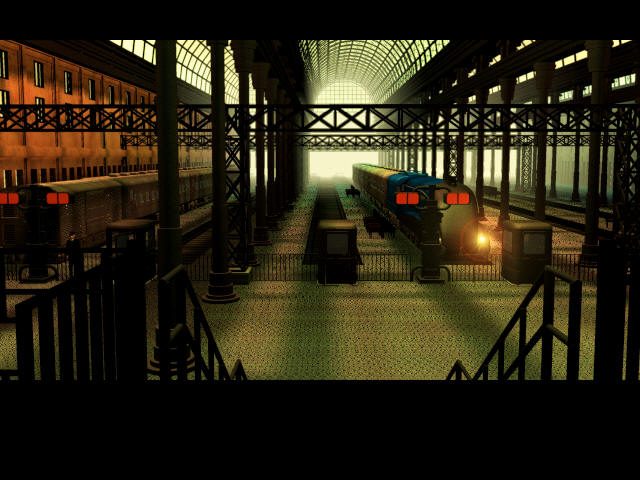
I've beat it a few days ago (it only takes about 2 hours), and I had been trying to write something here since then... But I just can't. I loved it and I can't sum up exactly how good it is.
It suffers from not being an actual game, more like an interactive movie, but it managed to create a fascinating universe and intriguing story, with lots of eye candy. It works on so many levels and it clearly influenced and reminds me of so many other games with its design (Half Life2, Bioshock, Fahrenheit, Last Express, FF7 or Lost Odyssey, heck even Shenmue...) One of the most original pieces I have had the delight to experience.
I realise haven't talked much about what it is: it plays as a first person adventure, like Myst, but with no real puzzles or gameplay. You just click around the places which you can see at leisure (including the various gadgets that give name to the game) and certain objects to progress the story. Many cutscenes intertwine the action and this, coupled with the setting, is where it shines. The story revolves is great, deep and philosophical, free for interpretation and lots of freak out sequences.
Lots of attention to detail as one would expect from a Japanese team.
*/10
Originally published July 10, 2009
Way of the Samurai - get back review
 No, not THAT way of the samurai ...
I had wanted to try this game for a long time, long before I even had a PS2. And, after that it still took me some time to get it, but I did manage to get one recently, and it was sealed and everything, joy.
On with it: The main draw of the game is to play multiple times, because what you do and don't do, affect how the story unfolds, much more than in, say, Raw Danger or Shadow of Destiny, sometimes just being at a certain place at a certain time has an outcome, but of course, choices based on text options are present as well. The story takes place in just 2 days and revolves around Rokkotsu pass, and more or less 4 factions. On one side there's the Kurou family that are historically the rulers of the pass. Then there's the Akadama clan, who are ruled by the Kurou boss' illegitimate son and want to bring back samuraidom ruling to Japan. Then there's the Meiji government (who historically ended the shogunates, this is XIX century) who intend to take control of the pass. In the middle of it all are the people who Rokkotsu, mainly a restaurant, a foundry, a swordsmith and a railroad track.
To get the full understanding of what's going on, you really have to play through it at least twice. Thankfully, and while I did only beat the story on my third try (because when you die, it's really gameover and you have to start from the beggining, oops), you can play through the game in about 1 hour and 30 minutes, which is perfect, as you can do it all in one sitting.
What I liked the most about it, is how the characters, in small number, and the situation, resembled so much a play, in that they were quite multidimensional, and while some were holier than others, everything was justifiable and it all made sense. Tough but fair, weak but honourable.
What I didn't enjoy as much was that it included some atmosphere breaking elements. The whole of Akadama clan dress up in a typical JRPG fashion (and haircuts) and the inclusion of an english woman and an afro samurai was also more or less weird hehe.
A final note for the music. While there aren't many different tracks (after all, a single playthrough is very short) I found them to be quite interesting choices. It ranges from very pleasing more or less epic tunes to a very Shenmue-like ambience tune, to traditional japanese music, and the battle theme is also an atmosphere breaker, using a more rock-ish tune with guitars (both electric and spanish), but this, as a whole, gave it a certain flair and made it stand out from other games rooted in historical Japan like... Ôkami or Cosmology of Kyoto, for instance.
All in all a nice surprise (it didn't exactly get stellar reviews) and an interesting game to enjoy.
Originally published July 25, 2009
Subscribe to:
Posts (Atom)